How GM engineers are warming EV batteries from the inside out
2026-08-04
By: Madhu Raghavan, Senior Technical Fellow
Summary: GM engineers are rethinking how EV batteries handle cold weather by warming them from the inside out. Instead of relying only on external coolant loops, GM’s battery AC heating uses carefully controlled pulses of alternating current to generate heat directly within the cells. This approach demands tight coordination across electrochemistry, power electronics, controls, and thermal management. By using existing propulsion hardware moreintelligently, GM aims to improve cold-start performance, charging readiness, battery durability, and overall energy efficiency in winter conditions. At a physics level, those AC pulses create resistive (I²R) heating in the electrodes, current collectors, and tabs, converting electrical energy into heat exactly where the battery is coldest.
Ensuring optimal performance in cold weather
Electric vehicles are engineered to perform in a wide range of conditions, including hot and cold climates. The batteries powering electric vehicles perform best when operating within the right temperature window. In cold weather, that requires careful engineering so that the battery can charge and discharge power more effectively. As temperature drops, ion transport in the electrolyte slows and cell impedance rises, so the pack needs more energy to deliver the same power and to accept high charging currents without exceeding voltage or temperature limits. A battery that’s too cold can limit charging performance, reduce available power, and affect the overall customer experience. That’s why GM engineers are taking an inside-out approach, using the battery system itself to ensure optimal performance in colder conditions.
At the center of this work is battery AC heating, also known as pulse heating, where the current direction—and often its magnitude—is varied in a controlled way rather than flowing as a steady DC stream. By using alternating current (AC) to warm the battery from within, GM is reimagining battery preconditioning as an integrated vehicle function—one that brings together electrochemistry, power electronics, controls, and thermal management. The goal is a battery preconditioning approach that helps EVs warm up more quickly in cold conditions, improve charging readiness and performance, and enhance overall vehicle efficiency.
Heating the battery where it matters most
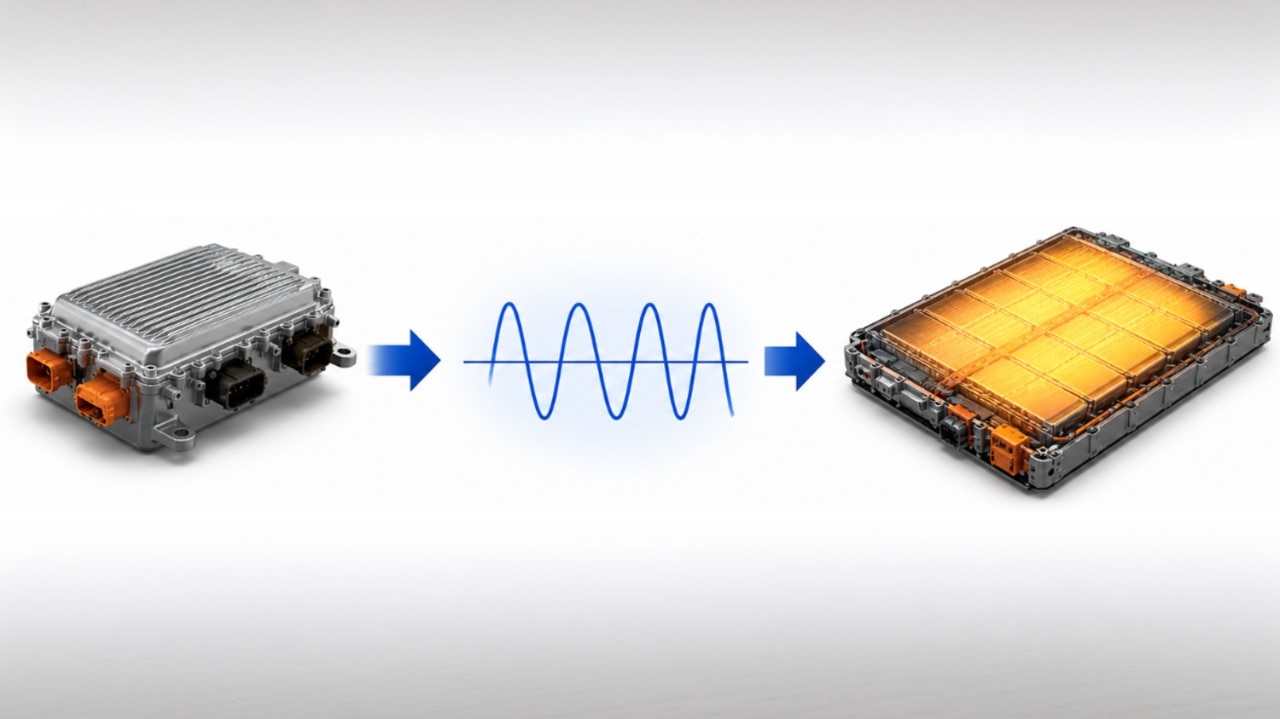
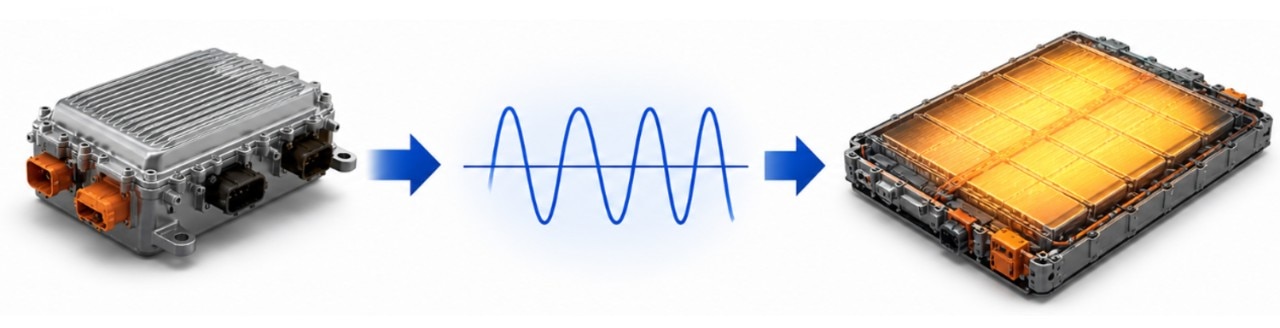
Traditional battery heating strategies move heat into the pack from elsewhere in the vehicle thermal loop. Battery AC heating takes a different path: rather than first heating coolant and then transferring that heat into the pack from the outside, this approach instead warms the battery more directly– sending quick pulses of current through the battery cells to generate heat within the battery pack. Think of it like a self-heating battery. Because the heat is generated inside the cell stack rather than in external coolant or plates, the active materials can warm more uniformly and quickly, reducing internal temperature gradients that are difficult to address with outside-in heating alone.
That distinction matters because it changes both where heat is created and how quickly it reaches the battery. In cold ambient conditions, AC heating can help the battery reach a more favorable operating state sooner, supporting both vehicle performance and charging capability.
Figure 1: Inside-out battery heating
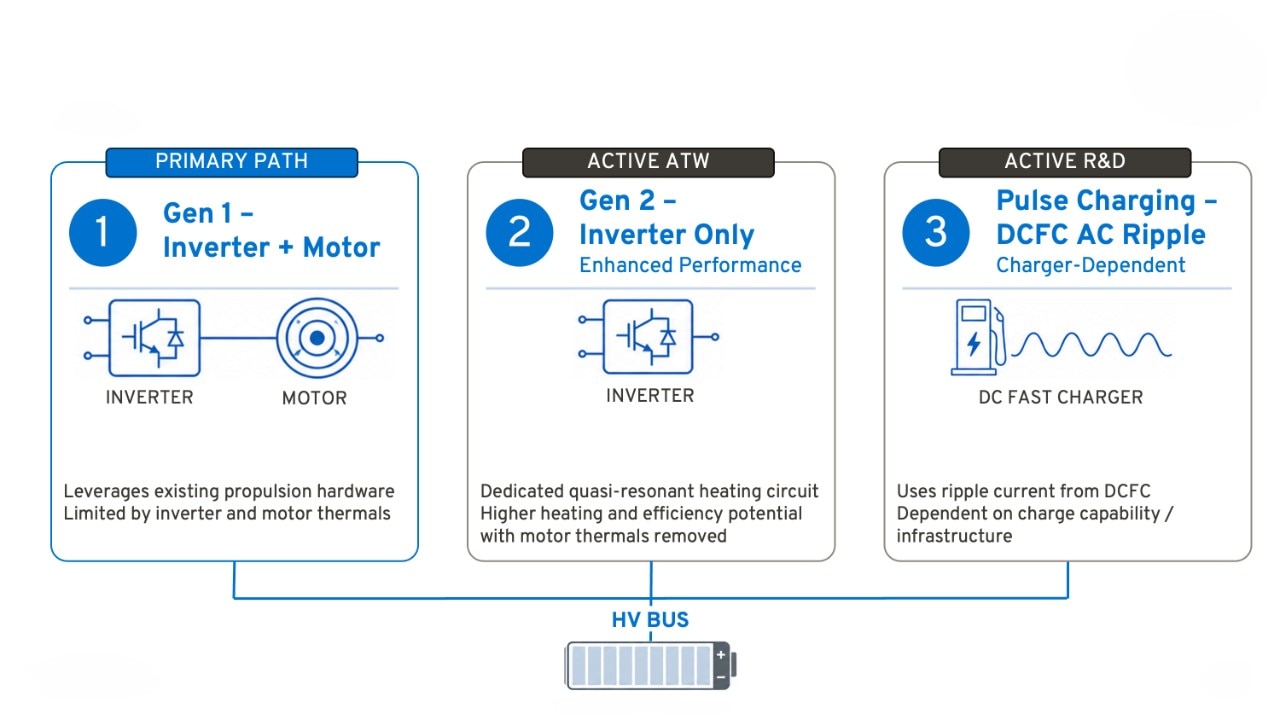
GM is exploring several ways to create the alternating current needed for different vehicle architectures and operating modes. The common goal is to use the vehicle’s existing electrical systems more intelligently to improve battery conditioning in cold weather.
A smarter way to precondition the battery
Battery pulse heating is designed to generate heat inside the cell while avoiding the electrochemical conditions associated with battery damage mechanisms in cold operation. Consequently, its design is constrained not only by thermal targets but also by electrochemical limits, control strategies, and power-electronics implementation. Practically, this means defining safe envelopes in current–temperature–state-of-charge space and ensuring that the commanded AC patterns stay within those envelopes, even under transients such as step changes in driver demand or ambient conditions.
From an engineering standpoint, battery AC heating is not simply a matter of running current through the pack. It requires the right operating strategy to create useful heating while maintaining battery health and durability. As a result, GM’s development work focuses on both thermal performance and electrochemical validation.
This is important because practical battery-heating technology must do more than warm the pack quickly. It must also preserve long-term battery performance, remain compatible with the entire vehicle electrical architecture, and work reliably across real customer use cases.
Figure 2: AC current source options
Managing electrochemistry as carefully as temperature
That’s why battery AC heating requires GM to manage electrochemistry as carefully as temperature. The work focuses on identifying operating conditions that generate useful heat inside the cell while avoiding side effects that could affect battery health. Particular attention is paid to low-temperature operation, where high overpotentials can otherwise drive lithium plating on the anode if currents are not carefully limited, reversed, or pulsed in a controlled way.
The goal is to warm the battery efficiently while protecting long-term durability. To support this, GM is combining system-level performance testing with detailed electrochemical analysis to validate AC-heating operating windows and understand how internal heating affects cell behavior and long-term battery health.
Using existing vehicle hardware in smarter ways
A key advantage of GM’s battery AC heating work is that it builds on hardware already in the vehicle. In one implementation path, the existing drive inverter and propulsion power electronics generate the pulse current needed for heating. In one such strategy, the traction inverter synthesizes a bidirectional current waveform around zero torque, so the wheels remain stationary while the pack still experiences the controlled AC current needed for internal heating. This creates opportunities to improve thermal performance without depending on a separate heating subsystem.
GM engineers have also investigated more direct battery-heating paths that reduce losses outside the battery and deliver energy more efficiently where it is needed most.
Together, these approaches show how propulsion components can do more than propel the vehicle. They can also support a more integrated thermal-management strategy that uses the EV’s electrical architecture more intelligently in cold weather.
A platform for faster cold-weather charging
Battery AC heating also supports a broader EV system goal: helping the battery reach a more favorable charging state in cold weather. The same internal-heating effect that warms the pack from a cold start can help prepare it to accept charge more effectively, while related work explores pulse-based charging approaches that may improve charging performance while supporting battery health.
Taken together, this work connects thermal management, charging readiness, battery life, and overall system efficiency. It also points to a more integrated future for battery conditioning—one tied more closely to the propulsion system, charging system, and controls strategy.
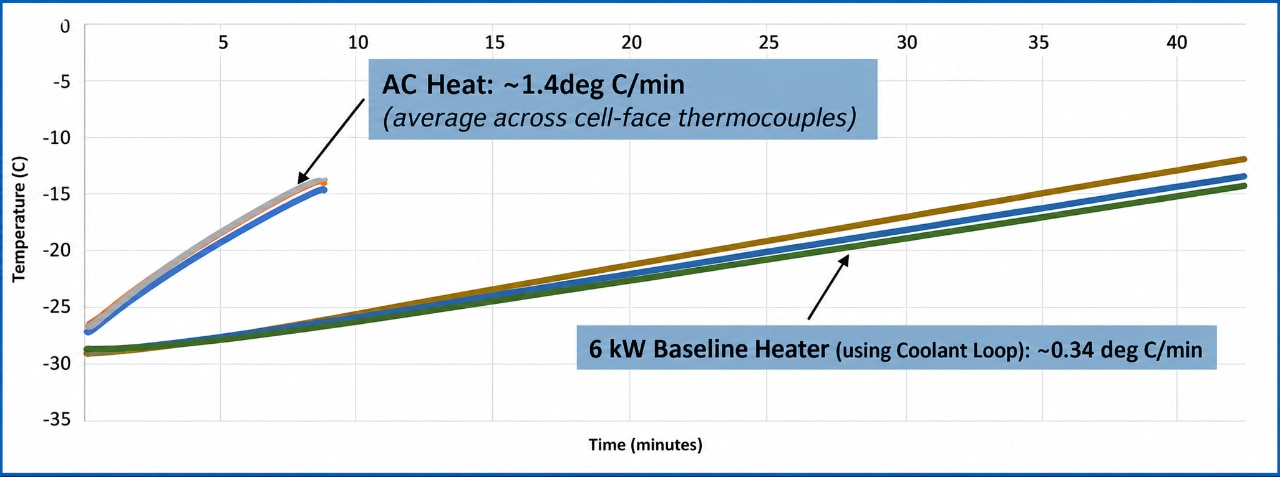
Figure 3: Experimental results
Redefining cold-weather EV performance
For drivers, the benefit of an EV better prepared for cold starts is straightforward. The EV is better positioned for charging in low temperatures and engineered to use energy more effectively when winter conditions are at their worst.
For engineers, the significance is broader. Battery AC heating shows how electrochemistry, power electronics, controls, thermal management, and charging strategy can be developed as one coordinated system. By treating the battery as an active part of the heating strategy and using existing vehicle hardware in smarter ways, GM is advancing a more integrated approach to cold-weather performance—one that can improve charging readiness, usability, and overall system efficiency.
More than a standalone thermal feature, battery AC heating offers a glimpse of how GM is engineering smarter, more connected EV systems for the road ahead.
By: Madhu Raghavan, Senior Technical Fellow
Summary: GM engineers are rethinking how EV batteries handle cold weather by warming them from the inside out. Instead of relying only on external coolant loops, GM’s battery AC heating uses carefully controlled pulses of alternating current to generate heat directly within the cells. This approach demands tight coordination across electrochemistry, power electronics, controls, and thermal management. By using existing propulsion hardware more intelligently, GM aims to improve cold-start performance, charging readiness, battery durability, and overall energy efficiency in winter conditions. At a physics level, those AC pulses create resistive (I²R) heating in the electrodes, current collectors, and tabs, converting electrical energy into heat exactly where the battery is coldest.
Ensuring optimal performance in cold weather
Electric vehicles are engineered to perform in a wide range of conditions, including hot and cold climates. The batteries powering electric vehicles perform best when operating within the right temperature window. In cold weather, that requires careful engineering so that the battery can charge and discharge power more effectively. As temperature drops, ion transport in the electrolyte slows and cell impedance rises, so the pack needs more energy to deliver the same power and to accept high charging currents without exceeding voltage or temperature limits. A battery that’s too cold can limit charging performance, reduce available power, and affect the overall customer experience. That’s why GM engineers are taking an inside-out approach, using the battery system itself to ensure optimal performance in colder conditions.
At the center of this work is battery AC heating, also known as pulse heating, where the current direction—and often its magnitude—is varied in a controlled way rather than flowing as a steady DC stream. By using alternating current (AC) to warm the battery from within, GM is reimagining battery preconditioning as an integrated vehicle function—one that brings together electrochemistry, power electronics, controls, and thermal management. The goal is a battery preconditioning approach that helps EVs warm up more quickly in cold conditions, improve charging readiness and performance, and enhance overall vehicle efficiency.
Heating the battery where it matters most
Traditional battery heating strategies move heat into the pack from elsewhere in the vehicle thermal loop. Battery AC heating takes a different path: rather than first heating coolant and then transferring that heat into the pack from the outside, this approach instead warms the battery more directly– sending quick pulses of current through the battery cells to generate heat within the battery pack. Think of it like a self-heating battery. Because the heat is generated inside the cell stack rather than in external coolant or plates, the active materials can warm more uniformly and quickly, reducing internal temperature gradients that are difficult to address with outside-in heating alone.
That distinction matters because it changes both where heat is created and how quickly it reaches the battery. In cold ambient conditions, AC heating can help the battery reach a more favorable operating state sooner, supporting both vehicle performance and charging capability.
Figure 1: Inside-out battery heating
GM is exploring several ways to create the alternating current needed for different vehicle architectures and operating modes. The common goal is to use the vehicle’s existing electrical systems more intelligently to improve battery conditioning in cold weather.
A smarter way to precondition the battery
Battery pulse heating is designed to generate heat inside the cell while avoiding the electrochemical conditions associated with battery damage mechanisms in cold operation. Consequently, its design is constrained not only by thermal targets but also by electrochemical limits, control strategies, and power-electronics implementation. Practically, this means defining safe envelopes in current–temperature–state-of-charge space and ensuring that the commanded AC patterns stay within those envelopes, even under transients such as step changes in driver demand or ambient conditions.
From an engineering standpoint, battery AC heating is not simply a matter of running current through the pack. It requires the right operating strategy to create useful heating while maintaining battery health and durability. As a result, GM’s development work focuses on both thermal performance and electrochemical validation.
This is important because practical battery-heating technology must do more than warm the pack quickly. It must also preserve long-term battery performance, remain compatible with the entire vehicle electrical architecture, and work reliably across real customer use cases.
Figure 2: AC current source options
Managing electrochemistry as carefully as temperature
That’s why battery AC heating requires GM to manage electrochemistry as carefully as temperature. The work focuses on identifying operating conditions that generate useful heat inside the cell while avoiding side effects that could affect battery health. Particular attention is paid to low-temperature operation, where high overpotentials can otherwise drive lithium plating on the anode if currents are not carefully limited, reversed, or pulsed in a controlled way.
The goal is to warm the battery efficiently while protecting long-term durability. To support this, GM is combining system-level performance testing with detailed electrochemical analysis to validate AC-heating operating windows and understand how internal heating affects cell behavior and long-term battery health.
Using existing vehicle hardware in smarter ways
A key advantage of GM’s battery AC heating work is that it builds on hardware already in the vehicle. In one implementation path, the existing drive inverter and propulsion power electronics generate the pulse current needed for heating. In one such strategy, the traction inverter synthesizes a bidirectional current waveform around zero torque, so the wheels remain stationary while the pack still experiences the controlled AC current needed for internal heating. This creates opportunities to improve thermal performance without depending on a separate heating subsystem.
GM engineers have also investigated more direct battery-heating paths that reduce losses outside the battery and deliver energy more efficiently where it is needed most.
Together, these approaches show how propulsion components can do more than propel the vehicle. They can also support a more integrated thermal-management strategy that uses the EV’s electrical architecture more intelligently in cold weather.
A platform for faster cold-weather charging
Battery AC heating also supports a broader EV system goal: helping the battery reach a more favorable charging state in cold weather. The same internal-heating effect that warms the pack from a cold start can help prepare it to accept charge more effectively, while related work explores pulse-based charging approaches that may improve charging performance while supporting battery health.
Taken together, this work connects thermal management, charging readiness, battery life, and overall system efficiency. It also points to a more integrated future for battery conditioning—one tied more closely to the propulsion system, charging system, and controls strategy.
Figure 3: Experimental results
Redefining cold-weather EV performance
For drivers, the benefit of an EV better prepared for cold starts is straightforward. The EV is better positioned for charging in low temperatures and engineered to use energy more effectively when winter conditions are at their worst.
For engineers, the significance is broader. Battery AC heating shows how electrochemistry, power electronics, controls, thermal management, and charging strategy can be developed as one coordinated system. By treating the battery as an active part of the heating strategy and using existing vehicle hardware in smarter ways, GM is advancing a more integrated approach to cold-weather performance—one that can improve charging readiness, usability, and overall system efficiency.
More than a standalone thermal feature, battery AC heating offers a glimpse of how GM is engineering smarter, more connected EV systems for the road ahead.