BVSeal™: How GM is rethinking battery leak detection
2026-08-04
By: Blair Carlson, Sr. Technical Fellow, Future Factory Research Program Lead
Summary: In modern vehicle manufacturing, achieving consistent quality at scale demands intelligent systems that can see, learn, and act in real time. At General Motors, maintaining robust, continually verified leak point detection in manufacturing is critical to delivering 100% quality in our vehicles. As manufacturing complexity and production speeds continue to increase, our engineering teams recognized the need for an even smarter, more scalable approach. BVSeal™ was developed to meet this challenge.
Understanding GM’s targeted, in-house solution
Born from close collaboration between GM manufacturing engineers, researchers, and plant teams, BVSeal is GM’s in-house optical-imaging leak-detection system used in manufacturing to find and localize leaks, especially in battery trays/packs. It combines advanced sensing, intelligent analytics, and seamless integration into plant operations. BVSeal enables pinpoint detection of leaking battery trays, reduces multiple iterations of inspection and rework, and supports consistent execution across high-volume production environments.
This article explores how BVSeal has evolved from a targeted solution to now helping to deliver measurable quality improvements that are redefining how GM builds vehicles at scale.
From a simple question to invention
Reducing the mass of vehicle battery trays and packs is critical to improving vehicle range, efficiency, and overall performance. To achieve that reduction, GM uses advanced high-strength steels (AHSS), new aluminum alloys, and resistance spot welding (RSW) for assembly. These lightweight materials improve structural efficiency, but they also introduce manufacturing challenges during welding. In AHSS, the higher carbon and alloying content that contributes to strength and mass savings can also promote the formation of hard martensitic microstructures in the weld fusion zone and heat-affected zone during the rapid heating and cooling of RSW. These hard, low-ductility regions can result in cracking as the weld solidifies and cools under severe thermal contraction stresses.
Early in development, the battery tray production team needed to answer a practical question: Could cracks in resistance spot welds create leak paths in the tray or pack enclosure? Existing inspection methods could not answer that question well enough. Computed tomography did not provide sufficient resolution to identify potential helium leak paths, and helium sensors, or “sniffers,” could detect the presence of tracer gas but could not reliably pinpoint the exact leak location because of environmental and geometry limitations.
To close that gap, the team built a benchtop prototype to test a different approach: imaging CO₂ escaping from a leaking weld. CO₂ also offered a practical advantage because it costs about one quarter as much as helium. Using a specialized combination of gas, camera, and filter lens, the team captured an image of gas emanating from a leaking experimental weld, as shown in Figure 1.
Figure 1 – Still image of gas emanating from a leaking experimental test weld #3
Although a new welding schedule eventually reduced AHSS spot-weld cracking, the team recognized a larger opportunity. Rather than only addressing cracking itself, they saw the potential to develop a production-ready method that could identify the exact source of a leak in real time on the manufacturing line.
How it’s done today
In traditional manufacturing, leak testing of battery trays and fully assembled battery packs is typically performed as a downstream, end‑of‑line (EOL) inspection process. After the tray or pack enclosure is fully assembled and sealed, it is tested against predefined leak-tightness limits using methods such as pressure decay, vacuum decay, tracer-gas helium testing, or immersion bubble testing. These methods are effective for determining whether a leak exists, but they typically provide only an overall leak result and not the precise location of the leak source—an important limitation in large, complex battery trays and packs with multiple welds, joints, and sealing interfaces.
As a result, teams may need to rely on manual troubleshooting, repeated testing, or even destructive teardown to find the root cause. For high-voltage battery trays and packs, where access is limited and safety requirements are stringent, that process becomes labor-intensive, time-consuming, and costly.
Verification in the laboratory
The battery tray and pack production team knew there must be a way to make repairs directly after leak detection, rather than the multiple rounds of leak detection and repair typically required through conventional means.
With the goal of developing a fully automated system that could easily identify the exact leak point in a production environment, the team constructed a full-size robotic cell with a known leaking battery tray, a collaborative robot holding a source for exciting gas escaping the battery tray, plus an additional collaborative robot with a camera and filter lens to capture the image of leaking gas. See Figure 2.
Figure 2 – Laboratory setup with camera and filter lens on one cobot and gas excitation source on the other.
To achieve automated detection of the leaking gas, the battery tray and pack production team had to overcome the technical challenge of identifying the leaking gas plume against a variable background and reflective surfaces. The team addressed this by creating two image-processing algorithms called Eye of the Storm and Fountainhead. The first identifies the source of gas accumulation, and the second identifies fountainhead created by dynamic control of the gas pressure.
Once the system was functioning, the team realized that a straight-line arrangement between the gas excitation source and the camera filter lens would limit how broadly the method could be used in production. Inspired by the way sunlight illuminates from above, they developed an overhead gas excitation source, making the system more practical and scalable for real manufacturing operations.
From prototype to production
While the team had demonstrated a functioning system that met the production time constraints, there remained significant work to convert a laboratory proven concept into a production-ready process.
A key next step was finding a way to excite the leaking gas for consistent detection on the production line. The team chose an infrared (IR) emitter incorporating a compact coiled tungsten filament that produces broadband, diffuse IR illumination. This non-obvious design eliminates hot spots and specular artifacts common to quartz or ceramic heaters, providing stable illumination across complex geometries and vertical surfaces.
The next challenge was integrating the IR emitter with the cobot operation in an open diagnostic station (no fences), while the battery packs arrived in the station by automated vehicle. In other words, the system must work safely and reliably in a shared production space while fitting within the timing and motion constraints of the manufacturing process.
A final requirement was precise, repeatable leak localization. To achieve this, a programmable pressure controller intentionally activates and deactivates leak sites. At the same time, synchronized AI algorithms identify the transientgas plume, track its direction and persistence, and spatially correlate its behavior across repeated activation cycles.
This capability became a defining strength of BVSeal. It introduces, a modular automation ecosystem linking PLCs, cameras, algorithms, pressure controllers, emitters, and cobots through real-time communication drivers and deterministic timing- to distinguish transient CO₂ plume signatures from background effects and precisely identify the exact leak point.
Figure 3 – Battery pack leak point detection system
A scalable leak point detection system
With its ability to detect leaks at the source, BVSeal minimizes rework, avoids costly battery tray and pack teardowns, and prevents defective units from advancing through the assembly line. The result is lower inspection labor, less material waste, and improved manufacturing throughput — capabilities that support scalable, high-volume EV production at lower cost per vehicle.
BVSeal was engineered as a scalable foundation rather than a single use solution. Its underlying architecture can be readily adapted to other high-volume applications—such as engine and powertrain assembly—where seal and joint integrity are equally critical. Ultimately, BVSeal does more than find leaks. It establishes a scalable manufacturing capability that strengthens product integrity for customers while driving efficiency, quality, and long-term value for GM.
By: Blair Carlson, Sr. Technical Fellow, Future Factory Research Program Lead
Summary: In modern vehicle manufacturing, achieving consistent quality at scale demands intelligent systems that can see, learn, and act in real time. At General Motors, maintaining robust, continually verified leak point detection in manufacturing is critical to delivering 100% quality in our vehicles. As manufacturing complexity and production speeds continue to increase, our engineering teams recognized the need for an even smarter, more scalable approach. BVSeal™ was developed to meet this challenge.
Understanding GM’s targeted, in-house solution
Born from close collaboration between GM manufacturing engineers, researchers, and plant teams, BVSeal is GM’s in-house optical-imaging leak-detection system used in manufacturing to find and localize leaks, especially in battery trays/packs. It combines advanced sensing, intelligent analytics, and seamless integration into plant operations. BVSeal enables pinpoint detection of leaking battery trays, reduces multiple iterations of inspection and rework, and supports consistent execution across high-volume production environments.
This article explores how BVSeal has evolved from a targeted solution to now helping to deliver measurable quality improvements that are redefining how GM builds vehicles at scale.
From a simple question to invention
Reducing the mass of vehicle battery trays and packs is critical to improving vehicle range, efficiency, and overall performance. To achieve that reduction, GM uses advanced high-strength steels (AHSS), new aluminum alloys, and resistance spot welding (RSW) for assembly. These lightweight materials improve structural efficiency, but they also introduce manufacturing challenges during welding. In AHSS, the higher carbon and alloying content that contributes to strength and mass savings can also promote the formation of hard martensitic microstructures in the weld fusion zone and heat-affected zone during the rapid heating and cooling of RSW. These hard, low-ductility regions can result in cracking as the weld solidifies and cools under severe thermal contraction stresses.
Early in development, the battery tray production team needed to answer a practical question: Could cracks in resistance spot welds create leak paths in the tray or pack enclosure? Existing inspection methods could not answer that question well enough. Computed tomography did not provide sufficient resolution to identify potential helium leak paths, and helium sensors, or “sniffers,” could detect the presence of tracer gas but could not reliably pinpoint the exact leak location because of environmental and geometry limitations.
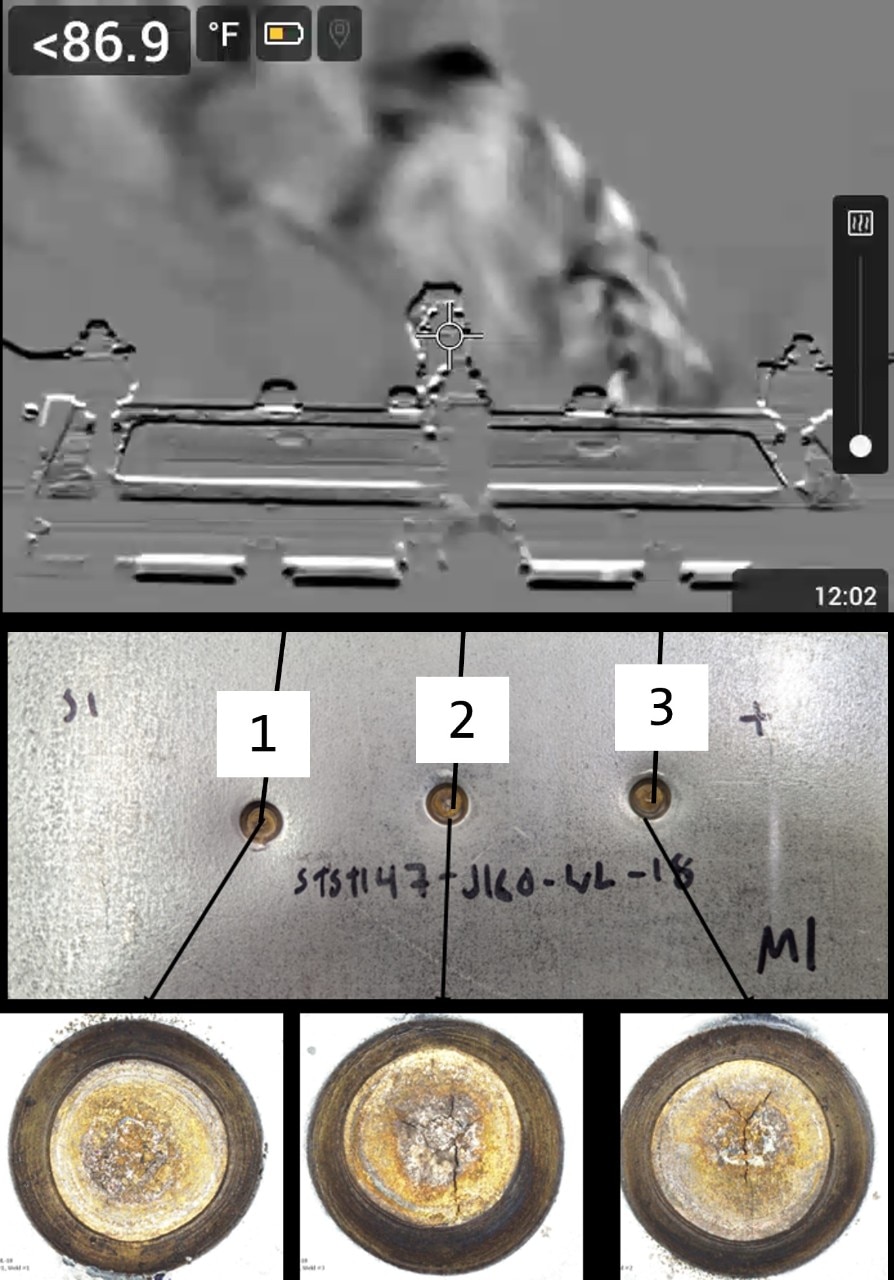
To close that gap, the team built a benchtop prototype to test a different approach: imaging CO₂ escaping from a leaking weld. CO₂ also offered a practical advantage because it costs about one quarter as much as helium. Using a specialized combination of gas, camera, and filter lens, the team captured an image of gas emanating from a leaking experimental weld, as shown in Figure 1.
Figure 1 – Still image of gas emanating from a leaking experimental test weld #3
Although a new welding schedule eventually reduced AHSS spot-weld cracking, the team recognized a larger opportunity. Rather than only addressing cracking itself, they saw the potential to develop a production-ready method that could identify the exact source of a leak in real time on the manufacturing line.
How it’s done today
In traditional manufacturing, leak testing of battery trays and fully assembled battery packs is typically performed as a downstream, end‑of‑line (EOL) inspection process. After the tray or pack enclosure is fully assembled and sealed, it is tested against predefined leak-tightness limits using methods such as pressure decay, vacuum decay, tracer-gas helium testing, or immersion bubble testing. These methods are effective for determining whether a leak exists, but they typically provide only an overall leak result and not the precise location of the leak source—an important limitation in large, complex battery trays and packs with multiple welds, joints, and sealing interfaces.
As a result, teams may need to rely on manual troubleshooting, repeated testing, or even destructive teardown to find the root cause. For high-voltage battery trays and packs, where access is limited and safety requirements are stringent, that process becomes labor-intensive, time-consuming, and costly.
Verification in the laboratory
The battery tray and pack production team knew there must be a way to make repairs directly after leak detection, rather than the multiple rounds of leak detection and repair typically required through conventional means.
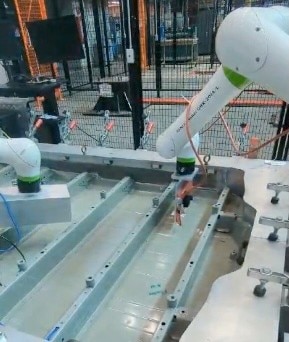
With the goal of developing a fully automated system that could easily identify the exact leak point in a production environment, the team constructed a full-size robotic cell with a known leaking battery tray, a collaborative robot holding a source for exciting gas escaping the battery tray, plus an additional collaborative robot with a camera and filter lens to capture the image of leaking gas. See Figure 2.
Figure 2 – Laboratory setup with camera and filter lens on one cobot and gas excitation source on the other.
To achieve automated detection of the leaking gas, the battery tray and pack production team had to overcome the technical challenge of identifying the leaking gas plume against a variable background and reflective surfaces. The team addressed this by creating two image-processing algorithms called Eye of the Storm and Fountainhead. The first identifies the source of gas accumulation, and the second identifies the fountainhead created by dynamic control of the gas pressure.
Once the system was functioning, the team realized that a straight-line arrangement between the gas excitation source and the camera filter lens would limit how broadly the method could be used in production. Inspired by the way sunlight illuminates from above, they developed an overhead gas excitation source, making the system more practical and scalable for real manufacturing operations.
From prototype to production
While the team had demonstrated a functioning system that met the production time constraints, there remained significant work to convert a laboratory-proven concept into a production-ready process.
A key next step was finding a way to excite the leaking gas for consistent detection on the production line. The team chose an infrared (IR) emitter incorporating a compact coiled tungsten filament that produces broadband, diffuse IR illumination. This non-obvious design eliminates hot spots and specular artifacts common to quartz or ceramic heaters, providing stable illumination across complex geometries and vertical surfaces.
The next challenge was integrating the IR emitter with the cobot operation in an open diagnostic station (no fences), while the battery packs arrived in the station by automated vehicle. In other words, the system must work safely and reliably in a shared production space while fitting within the timing and motion constraints of the manufacturing process.
A final requirement was precise, repeatable leak localization. To achieve this, a programmable pressure controller intentionally activates and deactivates leak sites. At the same time, synchronized AI algorithms identify the transientgas plume, track its direction and persistence, and spatially correlate its behavior across repeated activation cycles.
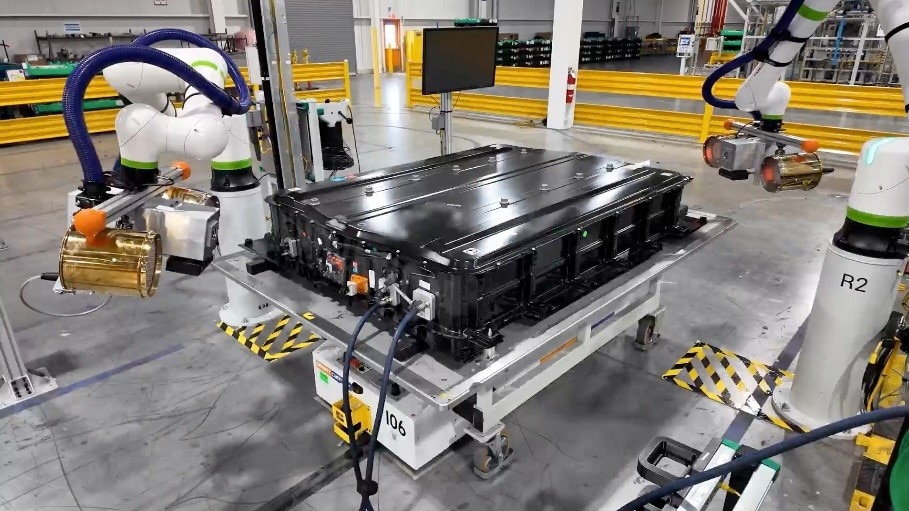
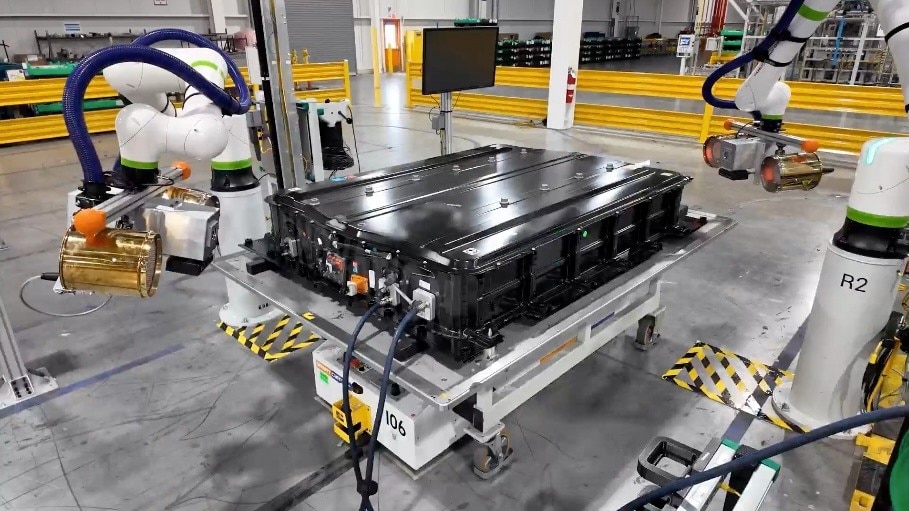
This capability became a defining strength of BVSeal. It introduces, a modular automation ecosystem linking PLCs, cameras, algorithms, pressure controllers, emitters, and cobots through real-time communication drivers and deterministic timing- to distinguish transient CO₂ plume signatures from background effects and precisely identify the exact leak point.
Figure 3 – Battery pack leak point detection system
A scalable leak point detection system
With its ability to detect leaks at the source, BVSeal minimizes rework, avoids costly battery tray and pack teardowns, and prevents defective units from advancing through the assembly line. The result is lower inspection labor, less material waste, and improved manufacturing throughput — capabilities that support scalable, high-volume EV production at lower cost per vehicle.
BVSeal was engineered as a scalable foundation rather than a single use solution. Its underlying architecture can be readily adapted to other high-volume applications — such as engine and powertrain assembly — where seal and joint integrity are equally critical. Ultimately, BVSeal does more than find leaks. It establishes a scalable manufacturing capability that strengthens product integrity for customers while driving efficiency, quality, and long-term value for GM.